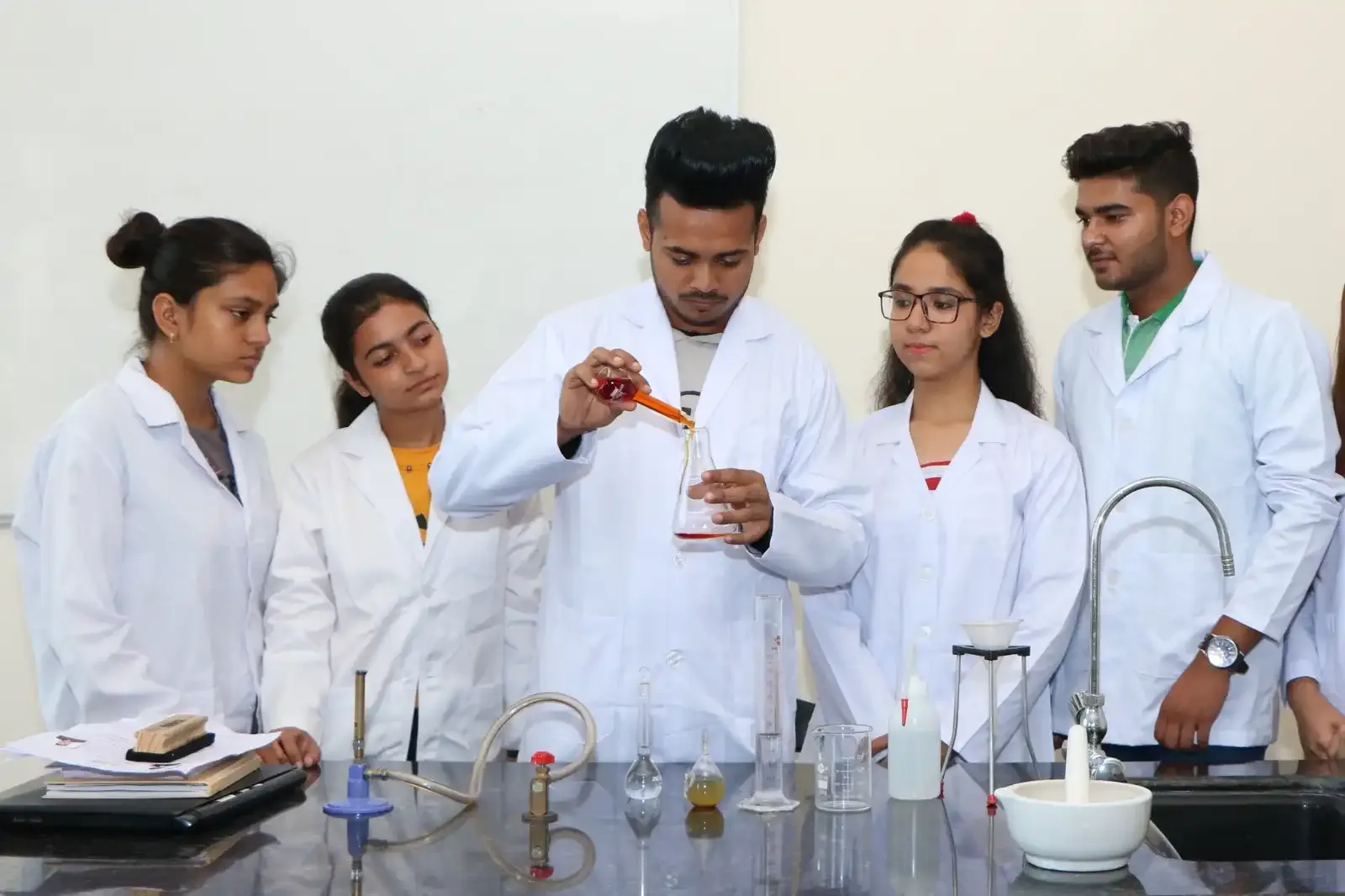
The Department of Applied Sciences at CT University, Ludhiana is dedicated to fostering curiosity and intellectual growth among students by building a strong foundation in both fundamental and advanced concepts of core engineering disciplines such as Mathematics, Physics, Chemistry, and Basic Electrical Engineering. The department adopts an effective teaching-learning methodology that integrates theoretical instruction with practical application, ensuring a comprehensive understanding of the subjects. To support this approach, the university provides state-of-the-art laboratories equipped with modern facilities for experiential learning.
Furthermore, the department actively organizes guest lectures, seminars, and workshops to enhance students’ comprehension of complex topics and expose them to emerging trends in science and technology. It also places significant emphasis on ethical engineering practices, aiming to shape professionals who are not only technically proficient but also guided by strong values and integrity.
Beyond academic excellence, the department encourages participation in a wide range of extracurricular activities, offering students opportunities to develop their talents and gain recognition for their achievements. Recognizing that career development is a gradual process, the university initiates guidance and mentoring from the very beginning of the academic journey. Through continuous career counselling and the collaborative efforts of faculty and students, the department strives to prepare individuals who are confident, competent, and capable of upholding the university’s standards of excellence in their professional careers.
Key Highlights

Recognised
CT University has obtained the recognition/approval of the Bar Council of India to run its Law programs under the School of Law. Approval by UGC under Section 2(f) of the UGC Act, 1956. Approval by UGC under Section 22 of the UGC Act, 1956.

Years Legacy
CT University owes its genesis to the establishment of the CT Educational Society in Jalandhar in the year 1997. After the legacy of more than 22 years, CTU was established in 2017 under the excelling vision of Sardar Charanjit Singh Channi, Chancellor, CTU.

of CT University in India?
CTU Overall ranking by IIRF is 133 out of 171 colleges in India in 2023 CTU is a widely recognised and awarded university in India. CTU has excelled in providing quality education across various disciplines and ranked 26 in the ARIIA Rankings

Experience
There is excellent placements and job opportunities in CT University. Almost 75-80% of students get placed in many big firms. Major Co.s which visit the campus are TATA Motors, HDFC Bank, Mahindra & Mahindra, etc. The average package offered is around 5–10 lakhs.

It is a foundational department that provides essential scientific and mathematical knowledge required for engineering disciplines.
The department typically offers courses in: - Mathematics - Physics - Chemistry - Environmental Science
Applied sciences help students develop analytical, problem-solving, and critical thinking skills that are essential for understanding core engineering concepts.
Primarily, first-year engineering students across all branches are enrolled, though some advanced or elective courses may be offered to senior students.
Yes, the department usually includes well-equipped laboratories for Physics, Chemistry, and sometimes Computer Science.
Students can pursue careers in engineering, research, data analysis, teaching, or further studies in specialized scientific fields.
Yes, many departments encourage research in areas like material science, applied physics, computational mathematics, and environmental studies.
It provides the theoretical and practical foundation needed for specialized engineering subjects in later years.
Yes, workshops, guest lectures, and seminars are often conducted to enhance student's knowledge and skills.
Yes, students can go for M.Tech, MCA, MBA, or research programs in interdisciplinary fields.
Mathematics forms the backbone of engineering, helping in modelling, analysis, and solving complex technical problems.
Yes, subjects like computational methods, materials science, and environmental studies often integrate multiple scientific disciplines.
Assessment typically includes internal tests, assignments, lab work, presentations, and end-semester examinations.
Yes, many departments guide students for exams like GATE, UGC-NET, and other higher education or government job tests.
Yes, students may undertake mini-projects or research-based assignments, especially in advanced semesters.
Experiments include mechanics, optics, chemical analysis, environmental testing, and basic programming tasks.
Yes, it often collaborates with core engineering departments for interdisciplinary teaching and research.
In many institutions, communication skills and professional development are integrated to prepare students for industry.
Facilities may include modern labs, smart classrooms, libraries, research centres and computing resources.
It promotes innovation through research projects, publications, workshops, and participation in scientific conferences.