Apply Now Programmes Virtual Tour CT-SET 2026 Ph.D
Admissions
Open 2026-27
Apply now
Apply Now

Master of Computer Application with Specialisation in Data Science and Artificial Intelligence - IBM

program-details

The school of Engineering and Technology (SOET), CT University offers 2 years Master of Computer Application with Specialization in Data Science and Artificial Intelligence - IBM is a postgraduate course focused on advanced computer science, application development, and software engineering. It equips students with strong programming, analytical, and problem-solving skills essential for IT careers. The curriculum covers areas like databases, networking, cloud computing, AI, web technologies, and cybersecurity.

Industry Immersion

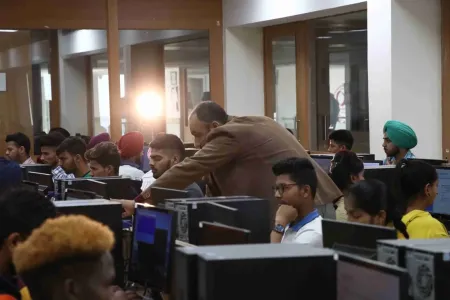
Industry immersion in Master of Computer Application with Specialization in Data Science and Artificial Intelligence – IBM provides students with real-world exposure through internships, live projects, and industry collaborations. It helps bridge the gap between academic learning and professional practices in IT and software industries. Students work on real-time challenges, understand industry workflows, and develop job-ready technical skills. Guest lectures, workshops, and company visits further enhance their understanding of emerging technologies. This experience boosts employability by building confidence, professional networks, and practical expertise.

Major Courses Offered

  1. Python + Clean Coding
  2. Data Visualization
  3. Artificial Intelligence
  4. Machine Learning
  5. Deep Learning
  6. Predictive Analysis
  7. NoSQL
  8. Devops
  9. Data Sciences
  10. Big Data Fundamentals
  11. BlockChain Technology
  12. Python for Data Science and AI
  13. Big Data Analytics
  14. Machine Learning and Deep Learning

eligibility criteria

Passed any graduation degree (e.g.: B.E. / B.Tech./ B.Sc / B.Com. / B.A./ B. Voc./ BCA etc.,) preferably with Mathematics at 10+2 level 
OR
at Graduation level Obtained at least 50% marks (45% marks in case of candidates belonging to reserved category) in the qualifying examination. (for students having no Mathematics background compulsory bridge course will be framed by the University for non technical students

Admission criteria

Merit in CT-SET, subject to fulfilling eligibility criteria.

Duration

2 Years

Curriculum

1ST SEMESTER SUBJECTS

Covers systematic approaches to software development, including requirements analysis, software design, testing, maintenance, and quality assurance. Introduces project management techniques such as planning, scheduling, risk management, cost estimation, and team management..

Provides advanced knowledge of computer networks, protocols, routing, switching, network architecture, and modern networking technologies. Develops understanding of network performance, wireless communication, QoS, virtualization, and emerging networking concepts.

Explores advanced concepts of relational database management systems, including database design, normalization, transactions, indexing, query optimization, and concurrency control. Provides practical understanding of database

Provides hands-on experience in designing, implementing, and managing relational databases using advanced SQL and database management tools. Students practice queries, stored procedures, triggers, transactions, indexing, security, and database optimization.

Develops advanced knowledge of data structures such as trees, graphs, heaps, hash tables, and advanced searching and sorting techniques using Python. Emphasizes algorithm design, complexity analysis, optimization, and problem-solving skills.

Provides practical implementation of advanced data structures and algorithms using Python programming. Students develop and analyze efficient solutions for searching, sorting, graph, tree, and optimization-based problems.

Introduces modern artificial intelligence concepts, machine learning techniques, and data analysis methodologies for solving real-world problems. Covers data preprocessing, visualization, predictive analysis, model evaluation, and practical AI applications.

An elective covering foundational concepts of artificial intelligence, including intelligent agents, search strategies, knowledge representation, reasoning, and an introduction to machine learning approaches.

Hands-on elective lab for implementing foundational AI algorithms and techniques covered in AI Concepts, including search, reasoning, and basic machine learning models.

An elective examining principles of network security and cryptographic techniques, including symmetric and asymmetric encryption, hashing, digital signatures, authentication protocols, and security threats and defenses.

Practical elective lab for implementing cryptographic algorithms and network security mechanisms, including encryption/decryption techniques, hashing, and basic security protocol simulations.

An elective introducing the R programming language for statistical computing and data analysis, covering data structures, data manipulation, visualization, and statistical modeling in R.

Provides hands-on experience in using R for data processing, statistical analysis, visualization, and interpretation. Students implement programs using R libraries and perform practical data analysis on real-world datasets.

2ND SEMESTER SUBJECTS

Introduces machine learning concepts, algorithms, and techniques for solving real-world problems using Python. Covers data preprocessing, supervised and unsupervised learning, model evaluation, feature engineering, and predictive analytics.

Provides practical experience in implementing machine learning algorithms using Python and relevant libraries. Students work with datasets to perform preprocessing, model training, testing, evaluation, and prediction.

Introduces concepts of data warehousing, ETL, dimensional modeling, OLAP, and data integration for organizational decision-making. Develops understanding of business intelligence techniques, dashboards, reporting, and analytical tools.

Introduces computational techniques that handle uncertainty, imprecision, and complex problem-solving beyond traditional computing approaches. Covers fuzzy logic, neural networks, genetic algorithms, and their applications in intelligent systems.

Develops an understanding of research methods, problem identification, literature review, research design, data collection, and analysis techniques. Enables students to formulate research problems and prepare structured project proposals with appropriate methodologies.

Provides a theoretical foundation for formal languages, automata, grammars, and computational models. Covers finite automata, regular expressions, context-free languages, Turing machines, computability, and complexity concepts.

Introduces blockchain architecture, distributed ledgers, consensus mechanisms, cryptographic principles, and decentralized applications. Covers smart contracts, blockchain platforms, digital assets, security, and real-world applications of blockchain technology.

Provides hands-on experience with blockchain concepts, platforms, wallets, transactions, and smart contracts. Students implement and test basic blockchain applications while exploring decentralized and secure transaction mechanisms.

Introduces fundamental and advanced techniques for generating, transforming, rendering, and visualizing graphical objects using computers. Covers geometric transformations, 2D/3D graphics, viewing, rendering, animation, and visualization techniques.

Provides practical experience in developing computer graphics and visualization applications using programming and graphics libraries. Students implement 2D and 3D transformations, rendering, geometric algorithms, animation, and visualization techniques.

3RD SEMESTER SUBJECTS

Covers the principles of securing computer networks and data through cryptographic techniques. Introduces symmetric and asymmetric encryption, hashing, digital signatures, authentication protocols, and key management. Explores network security threats, firewalls, intrusion detection systems, and secure communication protocols such as SSL/TLS and IPsec.

Provides hands-on experience implementing cryptographic algorithms and network security mechanisms. Includes practical exercises on encryption and decryption, hash function implementation, digital signature verification, and configuration of firewalls and intrusion detection tools using industry-standard software.

Explores advanced concepts in Java including multithreading, the collections framework, JDBC, servlets, and JSP. Covers design patterns, exception handling, networking with Java, and integration with databases for building robust, scalable applications.

Offers practical implementation of advanced Java concepts through programming assignments, including multithreaded applications, database connectivity with JDBC, web development with servlets and JSP, and applying design patterns to real-world scenarios.

Introduces fundamental concepts of image processing including image formation, enhancement, restoration, segmentation, and compression. Covers spatial and frequency domain techniques, morphological operations, edge detection, and an overview of image recognition and computer vision.

Provides hands-on practice implementing image processing algorithms using tools such as MATLAB or Python with OpenCV. Includes exercises on image enhancement, filtering, segmentation, edge detection, and basic object recognition techniques.

Covers the fundamentals of blockchain architecture, consensus mechanisms, distributed ledger technology, and smart contracts. Explores cryptocurrency systems, platforms such as Ethereum and Hyperledger, and blockchain applications in finance, supply chain, and other industries.

Offers practical exposure to blockchain development through hands-on exercises, including setting up blockchain networks, writing and deploying smart contracts with Solidity, and building simple decentralized applications.

Introduces formal models of computation including finite automata, regular languages, context-free grammars, and pushdown automata. Covers Turing machines, computability theory, decidability, and an introduction to complexity classes such as P and NP.

Provides an opportunity for students to design, develop, and implement a small-scale project applying concepts learned across the curriculum, fostering practical and problem-solving skills.

An elective covering the data science workflow including data collection, cleaning, exploratory analysis, statistical methods, and visualization techniques used to derive insights from data.

Hands-on elective lab applying data science techniques to real-world datasets, covering data preprocessing, analysis, visualization, and interpretation of results.

4TH SEMESTER SUBJECTS

Involves an in-depth, independent project where students design, develop, and implement a comprehensive software solution addressing a real-world problem. Emphasizes advanced technical skills, project planning, and professional documentation and presentation of the final outcome.

Provides students with exposure to real-world industry practices through a structured internship or training program with an organization. Focuses on applying academic knowledge in a professional setting, developing workplace skills, and gaining practical experience relevant to the field.

fees

Details

Amount

Programme Fees (per Semester)

70000

Examination Fees

3000

International Fees (per Year)

$3300

Programme Outcomes

  • Acquire comprehensive knowledge of key concepts and technologies in Full Stack Development, AI & Data Science, and Cyber Security & Forensics.
  • Improve the ability to assess complex problems and create effective solutions utilizing suitable technologies and methodologies.
  • Develop project management skills and the capacity to collaborate efficiently within multidisciplinary teams.
  • Nurture a research-driven mindset to investigate innovative solutions and contribute to technological advancements.
  • Embed a sense of ethical and professional responsibility in the practice of computing and technology.
  • Promote a dedication to lifelong learning and adaptability to stay current with evolving technologies and industry requirements.

Programme Specific Outcomes

  • Gain comprehensive knowledge and expertise in specialized areas such as Full Stack Development, AI & Data Science, Cyber Security & Forensics, and other emerging technologies. Develop the capability to apply these skills in practical settings to create innovative solutions.
  • Cultivate the ability to combine knowledge from various specializations to analyze and solve complex problems. Enhance analytical and critical thinking skills to address challenges across multiple domains of computing and
    technology.
  • Foster a strong commitment to ethical practices and professional responsibilities in computing. Encourage lifelong learning, adaptability, and effective teamwork to meet the evolving needs of the technology industry.

Salient Features

  • Focus on advanced programming, application development, and system design.
  • Industry-oriented curriculum with updated technologies like AI, ML, cloud, and cybersecurity.
  • Strong emphasis on practical learning through labs, projects, and internships
  • Opportunities for industry immersion, live projects, and corporate collaborations.
  • Development of both technical skills (coding, software development) and soft skills (communication, teamwork)
  • Placement assistance and training programs for better career opportunities
  • Flexibility to specialize in emerging areas like Data Science, IoT, Blockchain, etc.
  • Experienced faculty with academic and industry backgrounds.
  • Focus on innovation, entrepreneurship, and problem-solving mindset.

Infrastructure