Apply Now Programmes Virtual Tour CT-SET 2026 Ph.D
Admissions
Open 2026-27
Apply now
Apply Now

B.Tech. Computer Science and Engineering with Specialisation in Artificial Intelligence and Data Sciences – IBM (Lateral Entry)

program-details

As there is an enormous amount of data and to handle the data is one of the challenging tasks of various IT sectors. So, the Data Analytics and Artificial Intelligence has become an hour of need of today’s society. This course will help the students to become the emerging Data Scientists of the modern era.

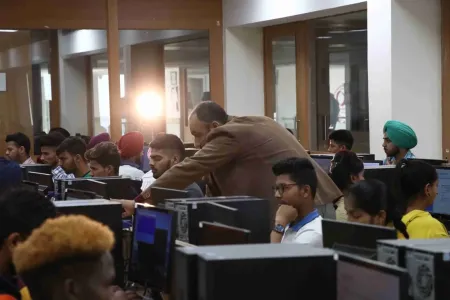
Industry Immersion

MAJOR COURSES OFFERED

  • Python + Clean Coding
  • Data Visualization
  • Artificial Intelligence
  • Machine Learning
  • Deep Learning
  • Predictive Analysis
  • NoSQL
  • Devops
  • Data Sciences
  • Big Data Fundamentals
  • BlockChain Technology

eligibility criteria

Passed Minimum 3-years / 2-years (Lateral Entry) Diploma examination with at least 45% marks (40% marks in case of candidates belonging to reserved category SC/ST) in any branch of Engineering and Technology with atleast 50% marks
OR
Passed B.Sc. Degree from a recognized University as defined by UGC, with at least 45% marks (40% marks in case of candidates belonging to reserved category SC/ST) and passed 10+2 examination with Mathematics as a subject.
OR
Passed D.Voc. Stream in the same or allied sector. (The Universities will offer suitable bridge courses such as Mathematics, Physics, Engineering drawing, etc., for the students coming from diverse backgrounds to achieve desired learning outcomes of the programme).

Admission criteria

Online and offline both.

Duration

3 Years

fees

Details

Amount

Programme Fees (per Semester)

85000

Examination Fees

3000

International Programme Fees (per Year)

Not Applicable

Modes of Payment

Slab >=60% - 74.99% >=75% - 89.99% >=90% & Above
Fee ₹80000 ₹75000 ₹70000

Students can avail these slots depending on the marks they have scored. Each slot reflects a different academic range, helping students understand where they stand and what benefits they qualify for.

Programme Outcomes

To make students engineering professionals, innovators or entrepreneurs engaged in technology development, technology deployment, or engineering system implementation in industry. To make students successful in applying modern computer science practice in data science, cyber security management as per Business needs in the international market.
To make students continue to acquire and demonstrate the professional skills necessary to be competent employees, assume leadership roles, and enjoy career success and satisfaction. To make students a productive citizen demonstrating high ethical and professional standards, make sound engineering or managerial decisions, and have enthusiasm for the profession and professional growth

Programme Specific Outcomes

A graduate of the Computer Science and Engineering Program will demonstrate: Design solutions for complex engineering problems and design system components or processes that meet the specified needs with appropriate consideration for the public health and safety, and the cultural, societal, and environmental considerations. Having an ability to be socially intelligent with good SIQ (Social Intelligence Quotient) and EQ (Emotional Quotient)
Having Sense-Making Skills of creating unique insights in what is being seen or observed (Higher level thinking skills which cannot be codified) The Graduates are expected to Create, choose, and apply suitable methodologies, resources, and modern engineering such as IT tools, including prediction and modeling to complex engineering activities, while keeping in mind the required limitations. The Graduates are expected to communicate efficiently with the engineering community and society at large on complex engineering tasks, such as being able to comprehend and write appropriate reports and design documents, give and receive specific guidance.

Salient Features

 Ability to develop a basic understanding of AI building blocks presented in intelligent agents. Ability to choose an appropriate problem-solving method and knowledge representation technique. Ability to analyse the strength and weaknesses of AI approaches to knowledge– intensive problem solving. Ability to design models for reasoning with uncertainty as well as the use of unreliable information.

How To Apply