The Department of Optometry at CT University is a center of excellence in vision science education, committed to developing healthcare professionals who are both skilled and compassionate. As part of the School of Allied and Healthcare, the department offers a five-year Bachelor of Optometry (B.Optom) program that blends theoretical knowledge with practical expertise.
Our mission is to create highly competent optometrists equipped with the technical know-how, clinical skills, and ethical understanding to meet the growing demands of eye and vision care. The curriculum is structured around the principles of Outcome-Based Education (OBE) and adheres to the AICTE Model Curriculum, ensuring quality and standardization in higher education.
With a strong focus on clinical training, the department prepares students to handle real-world challenges in diagnosing and managing ocular disorders. Students gain hands-on experience with advanced optometry equipment, participate in community eye care programs, and are groomed for both independent practice and collaborative roles in healthcare teams.
We aim to nurture professionals who are not only technically proficient but also socially responsible, capable of delivering compassionate care and contributing to national and global vision health initiatives.
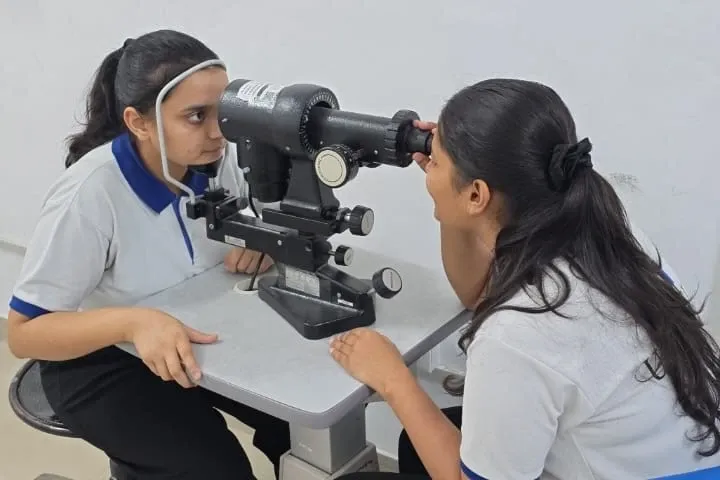

The instruction plan for the Bachelor of Optometry program at CT University is built upon a structured and flexible approach, adhering to the Outcome-Based Education (OBE) model as prescribed by AICTE. Instruction is delivered through a variety of teaching methodologies to ensure maximum engagement and comprehension. The modes of instruction include theoretical lectures, tutorials, practical sessions, and project-based learning, including summer internships and fieldwork. These are delivered in four distinct modes: Lecture (L), Lecture + Practical (L+P), Practical (P), and Project (PJ).
The learning plan of the Optometry program is focused on nurturing competent, ethical, and industry-ready eye care professionals through a holistic educational experience. Students are exposed to an interdisciplinary curriculum that blends core optometry subjects with basic sciences, open electives, and soft skills. The program emphasizes clinical proficiency, technological adeptness, and critical thinking, ensuring that graduates are capable of addressing complex vision care challenges.
Learning is not limited to classrooms; it is extended into labs, clinical settings, outreach camps, and research projects, allowing students to apply theoretical knowledge in real-world scenarios. The curriculum fosters lifelong learning habits, problem-solving capabilities, and a deep understanding of modern diagnostic tools and optometry equipment. Students are also encouraged to develop professional behaviors, including empathy, communication skills, and ethical decision-making, essential for building patient trust and delivering high-quality eye care services.

At CT University, we combine industry-integrated learning and global academic partnerships, backed by the CT Group's 30+ year legacy, to prepare students for careers that actually last.